
BOTTOM LINE: Fixing the size of the House of Reps, fixes the Electoral College.
Everyone hates the electoral college and says we should get rid of it immediately but then someone reminds us that it’s part of the constitution and you can’t just ditch it. Then everyone throws up their hands and says there is nothing to be done and move on to some other complaint.
But what if there was a fairly simple, as these things go, way to FIX it? (Since we can’t just get rid of it.)
The reality is the electoral college is just a number whose basis is described this way in the US constitution; “Each State shall appoint, in such Manner as the Legislature thereof may direct, a Number of Electors, equal to the whole Number of Senators and Representatives to which the State may be entitled in the Congress.” (Article II Sec 1)
The number of Senators is not easy to change, because two per state is set in the constitution. (Article I Sec 3) But the number of members in the house is set by population, (Article II, Sec 2) says “Representatives and direct Taxes shall be apportioned among the several States which may be included within this Union, according to their respective Numbers…” and that after they got the govt. up and running, in 1789-90, “The actual Enumeration shall be made within three Years after the first Meeting of the Congress of the United States, and within every subsequent Term of ten Years, in such Manner as they shall by Law direct. The Number of Representatives shall not exceed one for every thirty Thousand, but each State shall have at Least one Representative.”
This is the Constitutional root of the census, and the purpose is to count how many people there are in the USA in order to determine the size of the House of Representatives. It also says that the minimum number of people each Representative should represent is 30K. Today the average member of the US House represents over 770K citizens. Yes, over seven hundred and seventy thousand citizens, or more than 25 times the number that our Founding Fathers set, granted as a floor; but would they think it was right that all this time later the actual number would be so much higher.
Especially considering this bit of history concerning George Washington. Our first President and long considered the Father of our Country, due to his leadership of our Revolutionary Army, among other things; but still, he was apparently not a big speaker at our Constitutional conventions. “The size of the House was one of the most hotly debated issues at the Constitutional Convention in Philadelphia in 1787. The delegates initially proposed a figure of 40,000 people per congressional district. But George Washington thought this number was too high and on the only occasion in which he addressed the convention he asked that it be reduced to 30,000. This change was agreed to and that is what Article I, Section 2 of the Constitution requires.”
Maybe it is me, but I cannot imagine that our Founders would ever think that one representative would “represent” almost three quarters of a million people. There is no way one person can know and represent the needs and concerns of so many people, and clearly our founders knew this too because they increased the size of the house according to the census every ten years. While this increase is not specifically stated in the constitution it is implied by the requirement for the counting of population every ten years. And the fact that thought the lives of our original founders and beyond, this was the practice.
Then in 1911, after a lot of political wrangling the House was set at 435. This number was locked in in 1919 and there has been no political will to change it since. And so year after year, as our population has gone form less then 100m in 1910 to over 330m in 2023, our democracy has become diluted and our representatives have lost touch with the needs of the people.
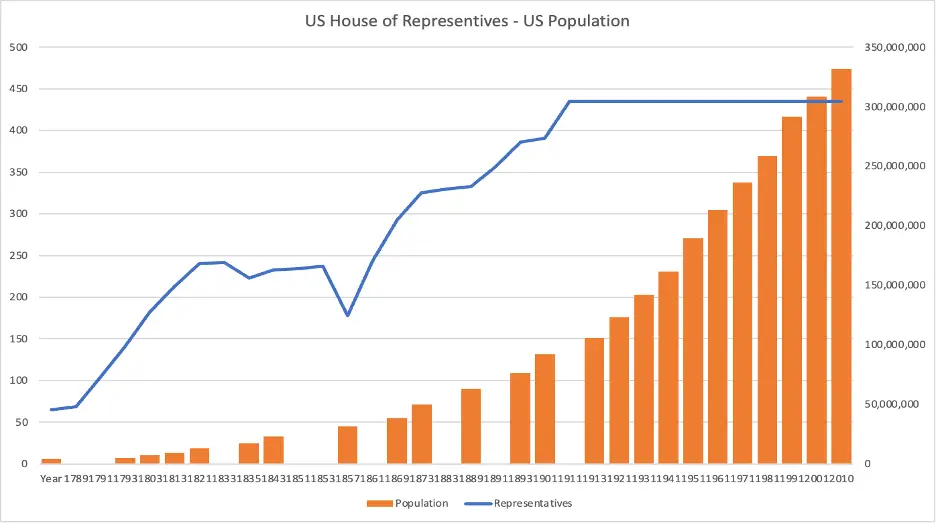
Even back then James Madison, in 1788 well before he became our 4th President, wrote about this issue and his fear that the House would become diluted, as it has. He wrote about this in Federalist Paper #55, and in a proposed constitutional amendment that specified how the number of Representatives would grow over time, but this amendment did not pass.
Today in the current congress, there are two bills before the House with the goal of expanding the House. HR 622 the REAL House Act which would raise the number of members to 585, and HR 643 the Equal Voices Act, which would raise the number of members to 573, using a formula based on the population of the smallest state.
The sad part is there is little interest, almost no cosponsors; and we all know these bills will go nowhere, but at least they are out there.
My feeling is neither of these goes far enough but a good start is better than no start. I’d go with the one with the biggest expansion and then work from there. The key is to start the conversation.
Expanding our representation and giving back the voice of the people through representation in the House is key and beneficial on its own; but getting back to the key point, expanding the House also expands the electoral college so it will more closely mirror the popular vote, which to me makes this an issue we should all care about right now.